Which Portable Solar Generator Is Best for Emergencies?
Power outages can occur without notice and continue for hours or days. Storms, wildfires, and power outages frequently leave families without electricity. A portable solar generator delivers clean, silent backup power when you need it most. However, not all models provide the same runtime or outcome. To select the best solution, you must first understand battery capacity, inverter strength, and charging flexibility. You must also calculate the amount of electricity your key appliances use. This tutorial discusses which qualities are most important and how to choose a portable solar generator that provides dependable emergency preparation.
What Makes a Portable Solar Generator Ideal for Emergency Backup?
Battery Capacity and Runtime for Essential Devices
Battery capacity determines how long a portable solar power generator can run your critical devices. Manufacturers measure capacity in watt-hours, which represent stored energy. To calculate runtime, divide the portable solar power generator's battery capacity by the total wattage of the connected appliances. For example, a 2,000 watt-hour battery can power a 200-watt load for around 10 hours. During an emergency, most homes prioritize refrigerators, medical equipment, routers, and lighting. Choose a portable solar power generator capable of handling these loads for several hours. Adding more storage enhances resilience during lengthy outages and lowers the danger of battery depletion.
Power Output, Surge Wattage, and Number of Outlets
The continuous output rating specifies how much electricity the generator can deliver at once. Surge wattage covers the brief bursts necessary when appliances start. Refrigerators and pumps frequently require more surge capacity than their operating load. If the inverter cannot manage starting spikes, the system may fail. Always match the surge rating to the appliance's needs. Also, consider the quantity and kind of outlets accessible. Several AC ports, USB connections, and DC outputs allow you to power several devices at once. Proper output capacity guarantees that operations remain steady and safe during an emergency.
Fast Charging Options: Solar, AC Wall, and Car Charging
Charging flexibility enhances emergency preparedness. AC wall charging allows you to completely charge the generator before the storm hits. Solar charging enables renewable replenishment during lengthy power outages. Higher solar input limitations reduce recharging time in bright sunshine. Car charging provides another alternative if you need to evacuate or relocate. Some modern versions enable simultaneous AC and solar charging for speedier recuperation. Evaluate the maximum input wattage and compatibility with available panels. Faster charging guarantees that the battery rapidly recovers to full capacity, providing consistent power throughout extended crises.
What Size Solar Generator Do You Need for Home Emergencies?
Running Critical Appliances: Refrigerator, CPAP, Router, and Lights
Begin by identifying the main equipment you must power. Depending on its size, a refrigerator might use anywhere from 100 to 800 watts. A CPAP machine usually requires 30 to 60 watts. Routers and LED lights usually require little electricity. Combine these data to get your total running load. Ensure that your generator's inverter can handle the complete power comfortably. Also, consider the surge needs for refrigerators. Accurate appliance evaluation avoids overload and assures steady operation when vital equipment must function continuously during outages.
Whole-Home Backup vs. Essential Circuits Only
Instead of powering a whole house, portable solar generators usually only power critical circuits. It takes a lot of battery capacity and a lot of inverter power to run all the appliances at once. In most cases, homeowners choose essential loads above comprehensive coverage. Extending runtime and decreasing system cost are achieved by prioritising important circuits. The necessity for whole-home backup or specific assistance should be carefully considered. You may pick the right generator size with the support of realistic expectations, which also increases reliability.
Calculating Watt-Hours for 24–72 Hours of Outage
To figure out how much energy you consume each day, multiply the wattage of your appliances by the number of hours they are on. If your necessities use 1,500 watt-hours a day, multiply that by the number of days you want covered. You would require at least 3,000 watt-hours of useful capacity to last for two days. Add a safety buffer to make up for things that don't work as well as they should. Bigger batteries provide you with more coverage and make protracted situations less stressful. Careful planning makes sure that your generator can handle real-life power outages.
Best Portable Solar Generator for Emergency Scenarios
Anker SOLIX F3800 Plus
The Anker SOLIX F3800 Plus provides high-capacity backup power with great scalability and output. It starts at 3.84kWh with 6,000W AC output and grows to 53.8kWh and 12,000W, which is adequate to power heavy-duty appliances and complete household circuits. Built-in NEMA ports provide power to central AC units, freezers, and EV or RV chargers at dual 120V/240V. With up to 3,200W of twin 165V solar input, it recharges in less than two hours under ideal sunshine conditions. It also enables charging from a 240V wall or generator. EV-grade LFP batteries, smart app control, and a five-year warranty guarantee long-term dependability and energy efficiency.
Anker SOLIX F3000
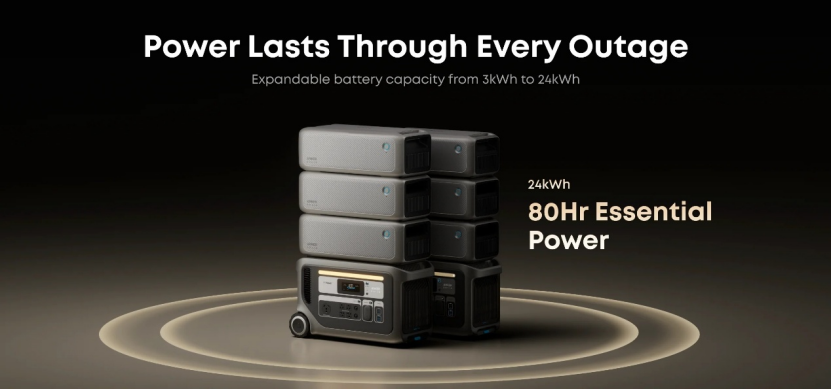
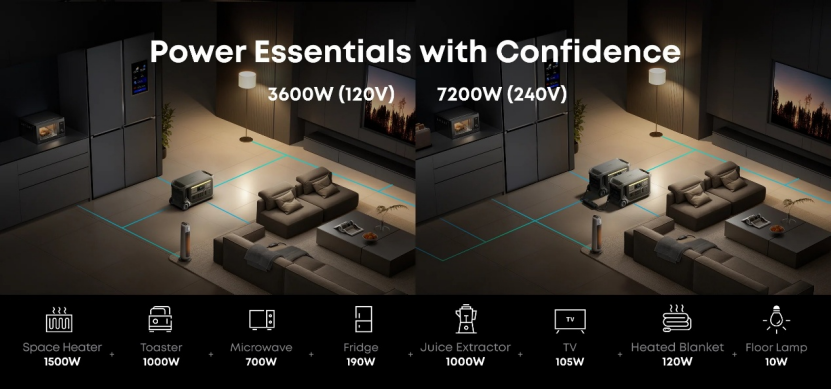
The Anker SOLIX F3000 provides versatile backup power while maintaining high performance and intelligent energy management. When coupled, it delivers 3,600W at 120V and increases to 7,200W at 240V, enough to power important or heavy-duty equipment. With a dual solar input of up to 2,400W, it recharges in around 1.5 hours of direct sunlight. Pass-through charging at 3,600W enables simultaneous charging and device use without interruption. Capacity ranges from 3kWh to 24kWh for week-long backup. Ultra-low idle consumption enhances standby and refrigerator runtime. Quiet operation, 20 ms switching time, and a 10-year lifetime offer dependable emergency and RV power.
Anker SOLIX C2000 Gen 2
The Anker SOLIX C2000 Gen 2 provides efficient and compact backup power for home and RV applications. It has a rated output of 2,400W and a peak power of 4,000W, making it suitable for 99% of typical appliances. With only 9W of idle use, it can power a dual-door refrigerator for up to 32 hours, which may be extended to 64 hours with an extra battery. Dual AC and solar charging achieves 100% in less than an hour. It also enables 800W alternator charging for rapid on-road replenishment. It weighs only 41.7 pounds and combines mobility, silent operation at 30 decibels, smart smartphone management, and a 10-year LFP battery life.
Conclusion
A portable solar generator that is capable of meeting your urgent energy demands while still producing sufficient power is the ideal emergency generator when it comes to solar electricity. The charging speed, the surge capability, and the size of the battery should all be taken into consideration. Analyse the practical watt-hour requirements, and then prioritise the most important appliances. In the event that there are unexpected disruptions to the power supply, a portable solar generator has the potential to serve as a dependable backup power source if it is designed and constructed appropriately.
Search Blog
Category
Hot Articles
-
Popular Company Party Prize Ideas
-
5 Best Practices for Tablet Maintenance and Care
-
A Guide to the Best Headphones for 2022
-
How to Charge Your Laptop without a Charger
-
Unleashing the power of innovation: HONOR 70
-
The Importance of Labels for Supvan: Six Reasons You Need Them
-
It's Time to Install a Solar Panel Generator
-
Understanding the New Innovative Launch of Honor in 2023
